
This article is based upon a learning circle call with a diverse group of partners and community change agents, serving communities to grow their wellbeing. It captures the main insights.
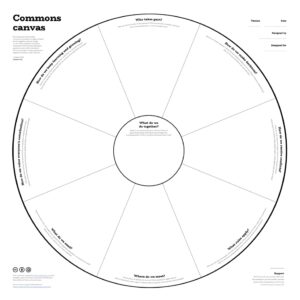
The Commons Canvas – a practical tool for communities to self-manage their commons and take forward community projects they like, in a sustainable way. It helps communities think through nine essential aspects of self-organization, such as:
- What do we manage together? – Land, energy, water, care, mobility, or other shared needs.
- Who are the members and owners? – People who contribute and benefit.
- How are decisions made? – Consensus, voting, rotating leadership, or other local methods.
- What rules apply? – And how are they monitored and enforced fairly?
- How do we resolve conflicts? – To keep the community strong over time.
- How do we finance it? – Through money, time, goods, or mutual exchange.
Here are the main take outs from our learning circle call, where we ask ourselves: can we use the Commons canvas and is it helpful for communities to take the lead?
It’s a tool for communities to use themselves
The whole purpose of the Common Canvas is to actually help citizens to think together about what kind of questions are important to self develop, to self organize in a world which seems to be driven very much by profits or by bureaucratic processes.
This Commons Canvas tool is based upon Eleanor Ostrom’s Principles for Governing Commons. It takes a lot of things from that. But it is made in such a way that it is useful for communities. It starts with the things we’re doing together here. What is our shared activity? Or our shared service? You can think of generating energy together, or sharing food, providing care, lending items, and what is the goal? And where does that go?
And from there, what you can do is talk about the questions. That can help us organize around this. The questions here are, who takes part? And you could talk about, who are the owners of the initiative? Do you need to become a member or not? How can people join or not? How do you make decisions together? How do you ensure those decisions are open and fair?
Not just a tool to set rules and take agency, also to self-govern
Ostrom also writes that it is good for commons to have a way of conflict resolution. So, if you have disputes, how do you resolve them together? You need to think about that. And then you can talk about rules. For example, the way you can become a member or maybe you need to pay contribution.
And of course, you need to think about how people actually are going to follow those rules and what happens if people misuse. Right, so that’s also a little bit of how this tool could work for governance in and by communities too.
Where do you meet to get these joint effort going. Is it a physical space? There’s probably also always some kind of resource you need, maybe a tool, a kind of support, expertise, equipment. Maybe you also need money. And how do you fund that? There’s a part that helps to discuss how to value everyone’s contribution? Give value to what other people do.
The Commons Canvas is accessible for every community
Because this Commons Canvas is published on the Commons license, really everybody could use it – free of charge. That’s also why this tool could be very powerful. Communities can download it from everywhere and use it.
It is close to how many communities are organising already. For example in Kenya 🇰🇪, the communities Grassroots Economy Foundation works with are really organized and all the aspects in this canvas is basically what they have in their constitution.
Also helpful tool for partners to communities.
Partners who are keen to support communities to take the agency and lead their own development, can use this tool too. Like in The Netherlands 🇳🇱, for example, in three sessions with people within different collectives, the Commons Canvas was very helpful. It just really helps to structure their ideas of how to organize themselves. So, what are the things that they are very well organized around, and what not. That becomes very clear with this canvas. It really helped them to structure and make visible what they’ve done so far, and what not. These collectives already exist for five to 15 years. Much of the stuff they’ve done, was just on the run and it happened. None if it was captured, till they used the Canvas. And now, to get a permit from the local government, it comes in very helpful. These peoples shared back, as feedback, that it has added a lot of value to them.
It offers a 360 degree perspective. For mapping and tracking.
The Common Canvas looks much like a 360 degrees mapping tool. And, it could also work as a tracking tool. Like, at one point in time we map something and then one year later we map again, and can see what change happened. We could visualize it with the same tool, in two time-stamped versions.
It has not yet been tried, to evaluate the use of the Commons Canvas after five or 10 years. But the hope is that this canvas will support communities or collectives to become more independent, and a strong force for good, next to all the good things that a government or a market does. Because markets and governments cannot solve all our issues. They just can’t. We need a different way to think also about how we organize ourselves as a society.
Not just tracking, it supports storytelling
So let’s say the community in DRC, supported by ASSIT can show several years in a row the community projects they’ve pulled off. This year they co-invest in clean water. With foreign capital, as well as with their own savings. And the labor from all neighbors. Next year they want to repair the road and so on, each year another picture is taken by their Commons Canvas. It’s not hard to imagine after three years they can actually engage an investor or a local government. They could track and trace the growth of commons, incomes, assets of a community. It’s clearly showing that they themselves are capable to grow their commons, their resources. As a community. In this way, it’s even a convincing tool for storytelling. As a way to engage more stakeholders. Showing how many households have been connected to this clean water project. making it easier to convey stories of the amount of women in those communities that gained more time to develop economic activities because family members were less sick because hygiene levels went up.
The nice thing about the commons canvas is, that it is actually owned by the community. All too often, stories we tell are funding-related. But with the Commons Canvas, these stories are community-driven. Stories about the commons in their own community, managed by themselves, built by themselves, prioritized by themselves, invested in by themselves. It’s actually a very strong narrative and they own it.
Be mindful to capture everybody’s voice – this requires a participatory process.
The Canvas in itself, does not have a process for implementation or usage included. It’s self-explanatory. It’s important for users to assure that everybody’s voice is captured. And similarly, that everybody’s value has been captured. The level of participation should be backed into the processes of usage.
What are the communication channels we use to get started? Who are the leaders we engage? Who are the people that have big networks, to include and make sure we have a proper reach?
Filling in this Commons Canvas, is likely to differ from community to community. When you want to have the biggest possible diversity of perspectives or interests with a seat on the table; then in every community or location it works differently to engage this diversity of people, because the networks are weaved differently in every community. It clearly requires to be embedded in a participatory process. And a process that is inviting for all to join in.
We hope you enjoyed the insights and can take some learnings forward. If you like to learn more, you can reach out to peers through our WhatsApp “Commons Canvas” community group ⬇️.