
Commitment Pooling from Kenya to India. Indian community organising structures Swavalamban Samitis from India back to Kenya.
Our Vidushi – Njambi Njoroge, shares her insights from the last part of our Global Mutualism Fellowship program: an immersion visit in Assam and a pilot with a community in Nashik, India.
When I traveled to India for the Global Mutualism cross-pollination program, I expected to learn about systems.
Instead, I learned about people.
For two weeks in Assam, I immersed myself in the work of the Drishtee,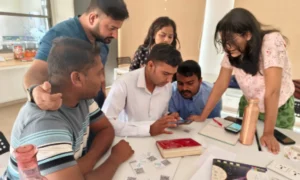 observing how rural communities organize themselves through Swavalamban Samitis, self-governed groups that coordinate economic activity, skills, and local enterprises. What struck me most was how naturally cooperation already existed. Women organized production groups, shared labor, supported one another through hardship, and coordinated resources within their villages.
The question that stayed with me was simple:
If cooperation already exists, how can we make it easier for communities to coordinate commitments and track their impact?
This question traveled with me from Assam to rural Nashik, where I conducted a one-month pilot with two Swavalamban Samitis: Devgaon and Wagera.
 But before introducing any technology, we started with something simpler.
Games!
Because sometimes the fastest way to understand an economic system is to play it.
* Before going further, it is important to clarify what this approach is and is not. Commitment pooling does not replace national currency, public services, or existing community institutions. It is a coordination layer for recording, exchanging, and fulfilling local commitments. In any adaptation, such a system would need to complement public policy, remain locally governed, protect community data, and operate within national legal and financial frameworks.
Making Invisible Value Visible: The Thread Game
The first activity we introduced was something we called the Thread Game to show trust and map resources.
At the start, everyone sat in a circle. One person held a ball of thread and shared something she had to offer the group. It could be anything: knowledge of mushroom farming, the ability to cook for community events, detergent production skills, childcare, farming labour, or help organizing meetings.
She then passed the thread to someone who needed that offer.
That person held the thread and named something she could offer in return, passing the ball onward to someone else who needed it.
Slowly, the thread stretched across the room.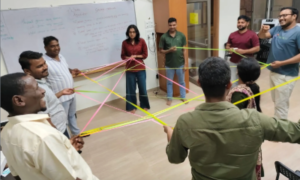
Line by line. Person to person.
By the end of the exercise, the group was connected by a web of string.
The visual was powerful.
Every line represented a relationship. Every connection represented an exchange waiting to happen. The room could suddenly see something that is normally invisible: a living network of value already present in the community.
This simple exercise surfaced two important insights.
First, every member already had something to offer.
Second, exchange already existed, but it was informal, scattered, and difficult to track.
The thread game showed the network.
The next step was to explore how commitments move within it.
Simulating a Market: The Card Game
The second exercise introduced a structured way to coordinate exchange.
Each participant received small pieces of paper. On each paper they wrote an offer, something they were willing to provide to the group.
Examples included: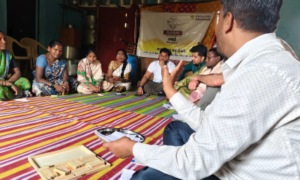
- Cooking meals
- Agricultural labour
- Food processing
- Detergent production
- Childcare
- Training in small business skills
Each paper represented a voucher for that service.
But the twist was that each offer was written twice.
One copy stayed with the issuer.
The other copy was placed in a shared pool.
The pooled papers represented offers that were publicly available to the group.
They then received small sticks with unique numbers written on them to represent a unit of the goods or service offered / issued
If someone wanted a service, for example cooking for an event, they could swap in their voucher ( Voucher A) for the voucher ( voucher B) of their service they need.
Later, the voucher B would be returned to the original issuer for redemption, represented by handing over the numbered stick.
The moment people began swapping papers in the pool and redeeming with the issuer, the room filled with energy.
Participants negotiated, exchanged, laughed, and tested different combinations.
What they were doing without realizing was simulating a community market built on commitments.
The important shift here was subtle.
Swapping a voucher from the pool did not mean owning the service.
It meant committing to exchange.
That distinction lies at the heart of commitment pooling.
Why Commitment Pooling Matters
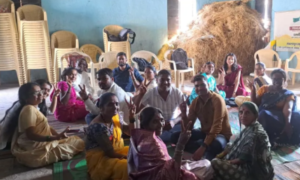
But these exchanges are often invisible.
They are not tracked.
They are difficult to coordinate across larger groups.And they can be forgotten over time.
Commitment pooling changes this.
Instead of relying on memory or informal arrangements, offers are explicitly recorded and pooled. Members can then exchange commitments in a structured way.
This approach has several advantages:
- Transparency – everyone can see what is available.
- Coordination – members can match needs with offers more easily.
- Accountability – commitments are traceable.
- Scalability – larger groups can cooperate without losing clarity.
Importantly, commitment pooling does not create cooperation.
It simply makes existing cooperation easier to organize.
* These advantages are real, but so are the risks. A pool only works when commitments are clear, redemption is trusted, group governance is fair, and limits are in place to prevent over-issuance or misuse. Without those safeguards, a digital record can reproduce the same confusion or power imbalance that already exists informally.
From Games to Digital Tools
Once participants understood the mechanics through the games, we introduced the digital tools.
Over three sessions we worked through: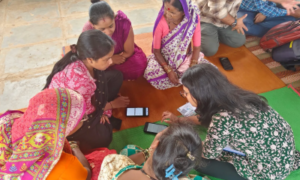
- creating simple digital accounts
- assigning readable names to those accounts
- creating vouchers backed by specific real offers
- pooling selected vouchers under group rules
- testing exchanges between members
* A low-tech or hybrid version is essential, especially where smartphone access, data costs, language barriers, or digital confidence differ across members.
Participants compared the digital swaps to the card game they had just played.
The connection was immediate.
What had previously been paper slips and sticks could now be coordinated digitally.
But learning technology takes time.
To help build familiarity, the groups adopted rotating leadership during meetings. At each session someone would become the host from an exercise where they would have blank folded papers and with only one paper with a mark. The one who would pick the marked one would automatically become the host.
Members sent part of their pooled commitments to the host for that session, giving that person temporary access to group resources under a known rotation rule.
The host cannot pick during the next session until they complete a cycle.
* check out examples of vouchers swapped in for the hosts vouchers on Sarafu Network Leadership rotated.
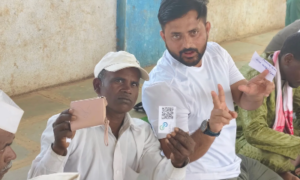 Responsibility rotated.
Access rotated.
This practice mirrored traditional labour rotation already common in rural communities.
Technology simply layered on top of existing culture.
That is exactly the test any adaptation would need to pass. Technology should not override customary cooperation, local leadership, or social trust. It should serve them. For public institutions and cultural stewards, the question is not whether the tool is novel, but whether it strengthens reciprocity, reduces administrative burden, protects dignity, and helps communities coordinate without creating new dependence on outside intermediaries.
Reporting and Impact Tracking
Each session includes a short reporting exercise led by the rotating session leader.
At the end of each meeting, members document:
- The activity that brought the group together (e.g., mushroom cultivation training, enterprise production, fellowship gathering, skill sharing, or planning meetings).
- The commitments exchanged and a picture of the activities during the session.
- The number of members involved in the exchange.
- The vouchers issued or swapped during the meeting.
- Location of the groups meeting
- Any goods or services delivered following earlier commitments.
Check out these reports that can be are shared on the Sarafu Network blockchain platform
For governments, community leaders, and participating families, transparency must be balanced with consent and privacy. Not every activity report or image should be public by default. A mature deployment would need clear rules on who can see what, how consent is gathered, how personal data is protected, and which records are kept locally versus shared more widely.
Purpose of Reporting
- Impact Tracking: It helps document the real economic and social activities happening within the group over time.
- Accountability: Members remain accountable to one another for the commitments they make.
- Learning and Reflection: Regular reporting encourages the group to reflect on how they are cooperating and what improvements can be made.
- Transparency: It allows the wider community and support teams to understand how the Swavalamban Samiti is functioning.
Over time, these reports will help build a clear picture of community-level economic activity, allowing both the Samiti and supporting organizations to observe patterns of exchange, growth in participation, and the development of local enterprises.
Two Samitis, Two Journeys
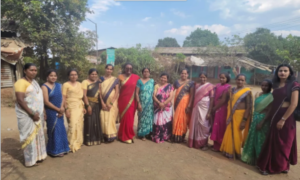
Devgaon was remarkably consistent. Fourteen women attended every session. They already had micro-enterprise groups producing detergent and food products, and their ambition was to expand participation to 200 women in the community.
Check out the Devgaon Samiti pool on the Sarafu Network
Wagera was newer and more fluid. New members arrived at almost every meeting. Their Vaani and her husband were deeply committed to supporting the community, but the group is still forming its long-term vision.
Both groups showed strong interest in the system and quickly understood the logic of commitment pooling.
What they need now is continued handholding as they grow comfortable using the technology.
Check out the Waghera Samiti Pool on Sarafu Network
Current Status and Continued Support
While I am now based in Kenya, I will continue remote handholding through WhatsApp groups and communication with the Drishtee field officers who were trained during the pilot.
These field officers will play a key role in: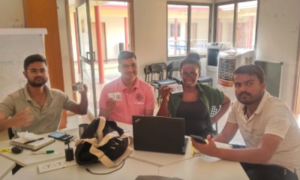
- Continuing digital training with the Samitis
- Supporting voucher issuance and swaps
- Guiding the reporting process
- Helping members grow comfortable with the technology
This approach ensures that the Devgaon and Wagera Swavalamban Samitis continue receiving support locally, while also allowing the learnings from this pilot to travel to new contexts.
Next Steps (Kenya Adaptation)
- Establishing a Mitra-style community hub
A local coordination point where community members can organize exchange and skill sharing. - Forming a governance group similar to a Swavalamban Samiti
A group responsible for guiding community activities and coordinating local economic initiatives. - Initiating skill development and transfer programs
Inspired by the enterprise groups observed in Drishtee communities. - The aim is not to replicate the Indian model exactly, but rather to adapt the principles of mutualism, community governance, and commitment coordination to the Kenyan context.
- Defining governance and safeguards before scale
Any adaptation should begin with clear local stewardship rules: who can issue vouchers, how values and limits are set, how disputes are resolved, how failed commitments are handled, how offline members participate, and what protections exist for the most vulnerable members. - Starting with narrow, high-trust use cases
The strongest starting points are likely to be practical and familiar: labour rotation, local procurement, caregiving, seasonal agriculture, skill sharing, or community service commitments with clear redemption pathways. - Inviting aligned seed support without loss of community controlLocal businesses, philanthropists, and public-interest institutions may help by pre-committing purchases, guaranteeing selected vouchers, or funding coordination capacity, while leaving day-to-day governance with the participating group.