
Africa Vidushi’s – Global Mutualism Fellowship 2025
Every community already holds the knowledge of what it needs. Its members know the land, the available skills, and who can be trusted. Too often, however, outside intervention executes a pre-planned agenda, and departs before this local capacity has the chance to lead.
The Vidushi Global Mutualism Fellowship was founded on a simple premise: communities possess the inherent insight and leadership required to shape their own futures. Our role is not to impose external solutions, but to amplify existing strengths, partner during execution, and step back so local leaders can carry the momentum forward on their own terms.
This is the story of what that looks like in practice, the people making it happen, and the early signs that it’s working. We wanted to share it, because the progress we’re seeing belongs to everyone who’s been part of it.
What the Fellowship is
Vidushi is a Sanskrit word that means “a wise person.” We chose it because the whole approach rests on the belief that communities already hold plenty of wisdom of their own.
The Fellowship is part of a wider effort we the Move to Mutualism. It brings together people doing community work. This specific cohort (started in 2025) across Africa agreed they can learn from each other. Every couple of weeks they meet online, talk through the problems they’re facing on the ground, share what has worked for them, and figure out solutions together. There’s no fixed syllabus. It’s really a regular conversation between people who do this work as part of their life’s work.
Why we think this matters
A lot of programmes stop at delivering a service. We try to go a step further and help a community reach the point where it can run things on its own.
A few things make that possible. The work focuses on building something a community can keep going after we leave, not just a short project. People learn from each other, so what works in one place feeds into another. Problems get worked out together instead of alone. Over time, a network of like-minded practitioners builds up, people who understand each other’s challenges because they face the same ones. And Vidushi’s get to visit India and see Drishtee’s community-development model up close, learning directly from communities that already run their own affairs.
Most of the work comes back to four things that seem to come up everywhere, from in a village in Maharashtra, India or in in Kilifi County, Kenya:
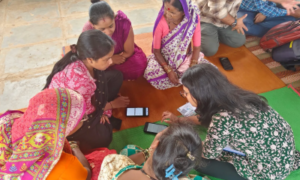
- Helping people organise and take charge of their own development.
- Setting up savings groups, community funds, and other ways to keep money working within the community.
- Building market links that benefit everyone, not just a few.
- Strengthening leadership, honest record-keeping, and the systems a community needs to manage its own resources.
How it works
The meetings are short and regular: about an hour and a half, online, once every two weeks. Nobody lectures. Each person brings a real problem from their own work, and the group helps them think it through. Over the months we cover things like organising communities, running savings and accounting systems, building livelihoods, reaching markets, and developing local leaders.
The people who take part tend to share one belief: that communities should own and run their own organisations. And they’re clear about their own role in that. They aren’t there to be the hero. They’re there to help, and then get out of the way so the community can lead.
Stories from the field
Two of our Vidushi’s, Zakari and Njambi, came to India to learn about Drishtee’s Swavalamban model and see how it might work back home in their own villages and neighborhoods in Africa. Their pilots were small, but they show the kind of change we’re after.
Zakari’s pilot in Devgaon and Waghera :
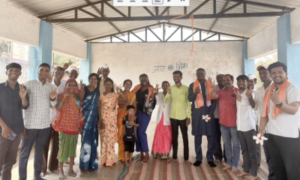 Zakari wanted to help two Swavalamban communities, in Devgaon and Waghera, set up their own savings chest. But it was never really about the money. It was about ownership.
He handed over the lead step by step. At first he ran the sessions himself, with Drishtee colleagues translating. Then the Drishtee team took over. By the end, the Swavalamban Samiti members were running the sessions on their own.
It happened over three sessions. The first got everyone talking about saving together and agreeing to start a community chest and balance sheet. In the second, the members mapped out and discussed their own resources. The third set up the Happiness Café Saving Pool.
By the end, one female and one male village committee member could run activities on their own. Both villages had resource maps that the members themselves had drawn and checked, and people clearly felt the balance sheet was theirs.
Njambi’s pilot in rural Nashik
Njambi tried something different but related: commitment pooling. The aim was to help village committees in rural Nashik coordinate better by tracking commitments between villagers with vouchers, and to move them slowly from paper exercises to simple digital tools.
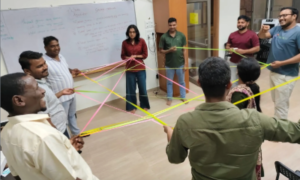 It went week by week. In the first week, people used threads to physically connect what they had with what they needed. Group enterprises like detergent and food processing came up alongside people’s individual skills. In the second week, they ran a card-game version of a market, issuing vouchers, putting them in a shared basket, swapping for what they wanted, and trying out redemption. In the third week it went digital, with wallets, vouchers backed by real offers, and pooling and “credit send” features.
A few things stood out. The idea fit well with how the community already worked. Drishtee field officers were trained to manage the digital side, so the work could continue after the pilot. And the paper-and-thread exercises turned out to matter a lot, because they made people comfortable before any phones or apps came into it.
Taking it home
Both Zakari and Njambi have since gone back to their own countries, and the pilots didn’t end when they left. The two visits went well enough that their organisations and Drishtee are now setting up longer-term collaborations to keep the work going.
Niger: Drishtee and Potentiel Terre
Zakari’s organisation, Potentiel Terre, is partnering with Drishtee on the back of the Devgaon and Waghera pilot, which ran under this Global Vidushi Mutualism Fellowship – Africa 2025. That pilot strengthened the Swavalamban Samiti model through community savings chests, participatory planning, and giving communities ownership of their own development, and it showed how well the two organisations work together.
Going forward, the two of them plan to:
- Develop the visual resource-mapping (community balance-sheet) approach further, and build simpler planning tools that communities can use on their own.
- Keep building local capacity, including Training of Trainers and the 4C framework for spotting and supporting community leaders.
- Look into financial inclusion, such as bank correspondents and account access, and tie savings pools into community activities like the Happiness Café.
- Adapt the Swavalamban model and the savings approach to Potentiel Terre’s work in Niger, with both sides sharing knowledge and visiting each other to learn.
Kenya: Drishtee and Grassroots Economics
Njambi’s organisation, Grassroots Economics, is partnering with Drishtee on the back of the “Commitment Pooling in Nashik Rural” pilot. That work strengthened the Swavalamban model by introducing commitment pooling and bringing digital tools together with the community’s existing practices, and again showed strong alignment between the two teams.
Their plans together include:
- Training of Trainers for Drishtee’s Master Trainers and field officers, covering the thinking behind commitment pooling, the thread and card games, and managing the digital tools (wallets, vouchers, swaps).
- Putting together a standard curriculum and translating the training materials into local languages.
- Linking commitment pooling to Drishtee’s skill-development and micro-enterprise work, and using the “rotation of labour” practice so digital leadership is shared rather than held by a few.
- Adapting the wider Swavalamban model to Grassroots Economics’ work in Kenya, with shared ways of measuring impact and documentation written by both sides.
This is just the start
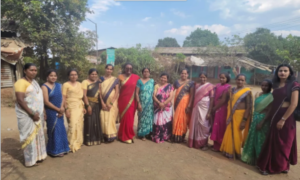
For us, the Vidushi Global Mutualism Fellowship isn’t really a one-off programme. It’s part of a growing way of working that trusts communities to lead, helps them coordinate, and lets people learn from one another.
Zakari and Njambi’s pilots are early days, but they’re a good sign of what happens when communities get the room and the support to run things themselves. We’re glad to share them, and there’s more to come as this work spreads across India and Africa.